
A solar battery stores surplus electricity generated by your solar panels during the day so you can use it at night or during a blackout. In simple terms, when your panels produce more energy than your home needs, the extra goes into the battery instead of being sent back to the grid. When the sun goes down, your home draws from the battery first before pulling any power from the grid.
That is the one-paragraph version. The reality involves direct current versus alternating current conversion, a battery management system, an inverter, and a bit of clever software that decides what energy should go where, moment to moment. None of it is complicated once you see the full flow.
This guide walks through how solar batteries work in plain English, what the key components do, how energy moves through the system, and what actually happens during a grid outage.
The basic energy flow
A grid-connected solar and battery system has four main players: the solar panels, the inverter, the battery, and the grid itself. Electricity moves between them based on what your home is using and what the sun is doing.
On a sunny afternoon, the typical flow looks like this:
- Your solar panels generate DC electricity from sunlight
- The inverter converts DC into AC, which is what your home appliances use
- Your home draws the power it needs right now (fridge, air conditioning, lights)
- Any surplus charges the battery
- If the battery is full, the remaining surplus is exported to the grid for a small feed-in tariff
After sunset, the flow reverses:
- Your panels produce nothing
- Your home draws power from the battery first
- If the battery runs out, your home falls back to the grid
- When the sun rises again, the cycle restarts
This is why a battery is often described as a solar time-shifter. It moves surplus energy from when you generate it to when you need it, rather than creating new energy.
The key components explained
Solar panels
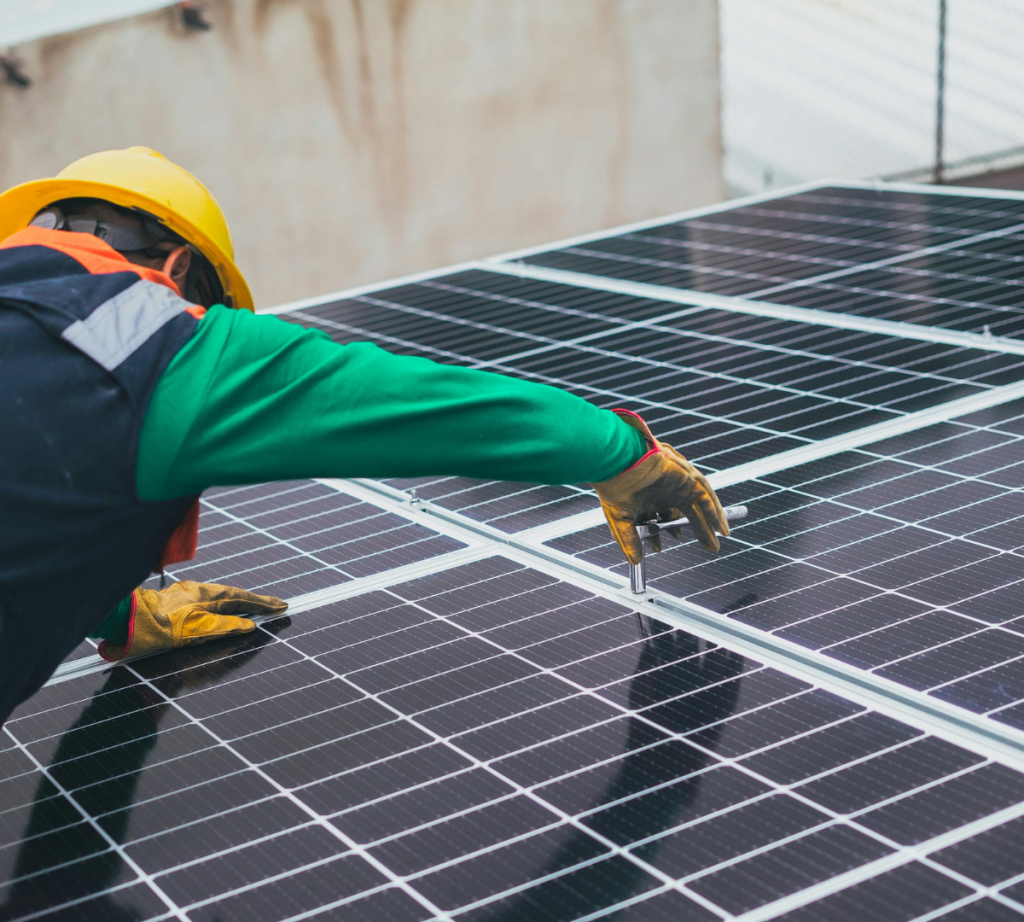
Solar panels are made up of photovoltaic (PV) cells that turn sunlight into direct current (DC) electricity. A typical residential panel produces around 400 to 450 watts in optimal conditions. A 6.6 kW system has roughly 15 to 18 panels. More detail on the panel side sits on the solar system page.
The inverter
Your home runs on alternating current (AC) at 230 volts, but panels produce DC. The inverter does the conversion. There are three common inverter types in battery-equipped homes:
- String inverter: converts solar DC to AC only. Needs a separate battery inverter if you want to add storage.
- Hybrid inverter: handles both solar and battery in one unit. Most common choice for new solar-and-battery installs.
- All-in-one battery unit: combines battery, inverter, and management system in a single wall-mounted package (e.g. Tesla Powerwall 3).
The inverter is also the brain of the system. It decides whether to charge the battery, discharge the battery, export to the grid, or import from the grid, based on conditions changing second by second.
The battery
The battery is the storage unit. Modern home batteries almost always use lithium iron phosphate (LFP) cells in Australia, which are safer, longer-lasting, and more stable than older chemistries. Inside the battery casing sits a stack of cells, a battery management system (BMS), cooling, and safety electronics.
The battery management system monitors each cell, balances charge levels, protects against overcharging or deep discharge, and talks to the inverter. This is why you cannot just wire random cells together. A proper home battery is a managed system, not a passive storage tank. The Clean Energy Council battery guide explains the certification process that approved batteries go through.
The switchboard and meter
The switchboard is where your home’s electrical circuits meet the incoming grid supply. A battery install usually requires the switchboard to be compliant with current standards. Older boards with ceramic fuses or missing safety switches often need a switchboard upgrade before a battery can be connected.
Your electricity meter, which most Queensland homes now have as a smart meter, records imports from and exports to the grid in real time. Your retailer uses this data to bill you for imports and credit you for exports.
DC coupled versus AC coupled: the two wiring approaches
Batteries connect to your solar system in one of two ways: DC coupled or AC coupled. The difference matters for efficiency and flexibility.
DC coupled. Solar panels send DC directly to the battery via a hybrid inverter. The inverter converts DC to AC only when the energy is used by the home or exported to the grid. This is slightly more efficient because there is one less conversion step when charging the battery. Best for new solar and battery installs built together.
AC coupled. Solar panels feed a standard string inverter that converts DC to AC for the home. A separate battery inverter then converts AC back to DC to charge the battery, then DC to AC again when discharging. There are more conversion steps, so efficiency is slightly lower, but it is much easier to retrofit to an existing solar system without replacing the inverter. Best for adding a battery to an older solar setup.
Round-trip efficiency, which is the percentage of energy you get back after charging and discharging, is typically 90 to 95 percent for DC coupled systems and 85 to 92 percent for AC coupled. The difference is small but shows up over years of operation. The choice also affects install cost, which is covered in our guide on how much solar batteries cost.
What happens during a blackout
One of the biggest misconceptions about home solar batteries is that they automatically keep the lights on during a grid outage. They do not, unless the system is specifically configured for backup.
Here is why. A standard grid-connected solar system is legally required to shut down during a grid outage, a safety feature called anti-islanding. This prevents the system from feeding electricity back into grid lines while utility workers might be repairing faults. That rule applies even if the sun is shining and the battery is full.
To keep running through a blackout, you need:
- A battery with backup capability
- A backup-rated hybrid inverter or a separate battery backup device
- A backup load circuit, which is a separate electrical circuit wired to the battery that only powers specified essential loads
- Correct switchboard configuration to isolate the home from the grid during backup mode
With those in place, the system detects the grid outage, isolates itself, and switches the backup load circuit to run from the battery. Essential circuits (usually fridge, lights, a few power points, internet modem) stay powered. Non-essential circuits (air conditioning, electric hot water, pool pumps) are usually excluded to preserve battery capacity.
For homes in storm-prone parts of southeast Queensland, backup capability is worth prioritising, and worth having an emergency electrician available for anything outside the battery’s scope. The energy.gov.au battery guide covers backup configurations in more detail.
What the battery decides, moment to moment
Modern battery management systems make thousands of small decisions a day. At any given moment, the inverter and battery management system are asking:
- How much solar is being generated right now?
- How much is the house using right now?
- Is there surplus, and if so, is the battery full?
- What is the current grid feed-in tariff, and what is the import tariff?
- Is the battery healthy and at a safe temperature?
- Is there a grid outage?
Based on the answers, the system decides whether to send surplus to the battery, export to the grid, discharge the battery to run the house, or do nothing. Advanced systems can also be programmed to charge from the grid during cheap off-peak windows if that provides a financial benefit, though this is uncommon in most solar-paired setups.
Newer systems are starting to integrate with virtual power plant (VPP) programs, where your retailer aggregates thousands of home batteries and dispatches them as a grid service during peak demand, paying you for participation. This is an emerging source of additional battery income that did not exist a few years ago.
Related questions
How does a solar battery charge?
A solar battery charges when your solar panels produce more electricity than your home is using. The surplus flows through the inverter into the battery. A battery can also be charged from the grid during off-peak hours, though this is uncommon for solar-paired residential systems.
Does a solar battery work at night?
Yes, at night the battery discharges to power your home, since the panels produce nothing. Once the battery is depleted, the home falls back to drawing from the grid until solar generation resumes the next morning.
How long does a solar battery take to charge?
A typical 10 kWh battery fully charges in three to five hours of strong solar generation from a 6.6 kW or larger system. Charging time depends on solar output, how much the house is drawing at the same time, and the battery’s charge rate specification.
Can I have a solar battery without solar panels?
Technically yes. A battery can be charged from the grid during cheap off-peak hours and discharged during peak hours. However, the financial case is much weaker than a solar-paired battery, and payback typically exceeds 15 years. The maths on this is covered in our post on whether solar batteries are worth it.
How does a solar battery know when to charge and discharge?
The inverter and battery management system monitor household electricity usage, solar production, and battery state of charge every second. They automatically direct energy to charge the battery when surplus is available and discharge it when the home needs power and solar is insufficient. You do not manually control any of this in normal operation.
Do solar batteries need maintenance?
Very little. Modern lithium home batteries are sealed and have no moving parts. An annual or biennial health check from your installer is the main service requirement, plus keeping firmware up to date. For more on lifespan and maintenance, see our guide on how long solar batteries last.
The short version
Solar batteries store surplus solar electricity during the day so you can use it at night. An inverter manages the flow between panels, battery, home, and grid, and a battery management system protects the cells and decides charging and discharging behaviour automatically.
The system works silently in the background, and beyond choosing the right size for your home and making sure the install is done properly, there is not much you need to do day to day. For Australian homes with existing solar and rising electricity bills, that quiet background operation is now saving most households $1,500 to $2,200 a year off their power bill.
If you want to understand how a battery would fit your specific solar setup, home size, and usage pattern, Essence Electrical runs a system-specific assessment that explains how the energy would flow through your home before quoting. Get in touch if you want a straight answer for your house.