
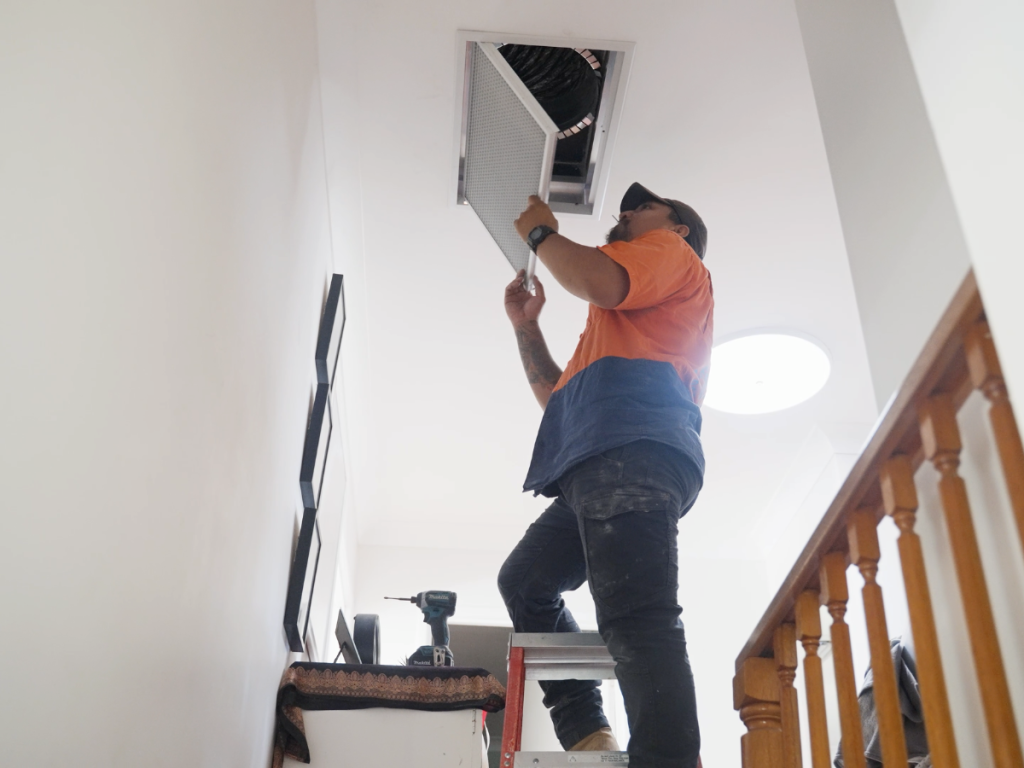
If you are pricing up ducted air conditioning for your home, the typical 2026 installed cost in Australia sits between $9,000 and $20,000 depending on house size, system capacity, and install complexity. Most Queensland family homes between 180 and 250 square metres end up in the $12,000 to $16,000 range for a quality reverse cycle ducted system with four to six zones. Smaller homes or retrofits into existing ceiling spaces can come in under $10,000. Larger two-storey homes or premium brands with advanced zoning push the number to $22,000 or more.
That range is wide because ducted air conditioning is not a single product. The price depends on the kilowatt capacity of the indoor and outdoor units, the number of zones, the brand and model, the ductwork run required, the condition of your roof space, and whether any electrical or switchboard work is needed. Two identical-sized homes on the same street can have genuinely different quotes based on those variables.
This guide breaks down what you actually pay in 2026, what drives the price up or down, and the running costs that often get forgotten at quote time.
What ducted air conditioning actually costs in 2026
For a fully installed ducted reverse cycle system, typical Australian quotes fall into these ranges:
- Small home, 3 to 4 zones, 10 to 12 kW capacity: $9,000 to $12,000 installed
- Standard family home, 4 to 6 zones, 14 to 16 kW capacity: $12,000 to $16,000 installed
- Large home, 6 to 8 zones, 18 to 20 kW capacity: $16,000 to $22,000 installed
- Premium brands with advanced zoning and smart controls: up to $25,000 for large systems
These figures include the outdoor condenser unit, the indoor fan coil (usually mounted in the roof cavity), flexible ductwork to each room, zone motors and controllers, return air grilles, ceiling vents, a wall-mounted controller, commissioning, and standard electrical work. They assume a straightforward install in a single-storey home with reasonable roof access.
What is often not included is switchboard upgrades if the existing board cannot handle the load, structural work for tight roof spaces, dedicated circuit installation, or removal of old systems. These are usually itemised separately in a proper quote. If your switchboard is older or running close to capacity, budget an additional $1,500 to $3,500 for a switchboard upgrade.
What drives the price up or down
Six factors quietly shift the final number more than most homeowners realise when comparing quotes.
System capacity (kW)
The kilowatt rating of the indoor and outdoor units is the single biggest cost driver. A properly sized 14 kW system will cost less than a 20 kW system, but an undersized unit runs constantly trying to cool your home and costs more to run while wearing out faster. Sizing needs to match both the total floor area and the building insulation, ceiling height, window orientation, and local climate zone. A rule-of-thumb calculation of 150 watts per square metre is a starting point, but an installer should do a proper heat load calculation before quoting, not an estimate.
Number of zones
Zoning lets you control different parts of the house independently. Most quality systems support four to eight zones, each with its own damper and controller. More zones means more comfort and lower running costs, but each zone adds $300 to $600 to the install cost for the damper, wiring, and controller. For most family homes, four to six zones hits the right balance between control and cost.
Brand and model
The brand matters more than people expect. Daikin, Mitsubishi Electric, and Fujitsu sit at the premium tier and typically cost 15 to 25 percent more than budget brands for the equivalent capacity. The price premium buys better compressor technology, quieter operation, longer warranties, and meaningfully lower running costs. Budget brands can be 20 to 30 percent cheaper upfront but often cost more in electricity over their lifespan.
Ductwork and install complexity
A single-storey home with a large, accessible roof space is cheap to install in. A two-storey home with a tight roof cavity, a cathedral ceiling, or exposed beams requires more labour and custom ductwork, which can add $2,000 to $5,000. Concrete slab homes with limited ceiling space sometimes need bulkheads built to house ductwork, which is a separate trade cost.
Electrical work
Ducted systems draw significant power and need dedicated circuits. Older Queensland homes sometimes have switchboards that cannot accommodate the additional load without upgrade. Dedicated circuits, new sub-boards, or switchboard replacement can add $1,500 to $4,000 depending on what is needed. A good installer will flag this at site inspection, not after install day. If you are not sure whether yours is compliant, a qualified electrician should inspect before you commit to a ducted quote.
Smart controls and app integration
Modern systems often come with Wi-Fi controllers and smartphone app control as standard, but advanced features like per-zone temperature sensing, scheduling logic, or integration with Sensibo or Google Home can add $500 to $1,500 to the project. Worth asking upfront what the quoted system includes.
Installation costs versus product costs
A common question is why two quotes with the same brand and capacity can differ by $3,000 or more. The answer is usually hidden in the installation line items, not the hardware. The compressor and fan coil account for roughly half the total cost. The rest is ductwork, zone motors, vents, controllers, electrical work, and labour.
Cheap quotes sometimes skimp on duct quality using thinner flexible ducting that leaks more air, or use fewer supply registers than the home really needs. Both hurt performance and increase running costs. Always ask whether the quote includes R1.0 or R1.5 insulated ducting, how many supply registers per zone, and whether the return air pathway is properly sized.
Running costs, which matter more than people think
The install price is only part of the cost picture. A ducted system runs for years, and running costs can easily exceed the install cost over the lifetime of the unit if the sizing and usage are wrong.
A well-sized 14 kW reverse cycle system running in cooling mode in southeast Queensland typically uses 3 to 5 kWh per operating hour. At 30 cents per kWh, that is roughly $1 to $1.50 per hour of operation. A household running the system four hours a day in peak summer months can expect $120 to $180 per month in cooling costs. Heating in winter runs around half that figure because Queensland winters are mild.
Zone usage matters enormously. Running three zones at once uses more energy than running one, even if the compressor is the same. Homes that habitually run all zones simultaneously end up with electricity bills that are 40 to 60 percent higher than homes that zone properly. The Energy Rating website publishes efficiency data for every approved model in Australia and is worth checking before committing to a brand.
If you have solar already installed, running the system during daylight hours is effectively free. Combined with a solar battery, ducted cooling becomes one of the cheapest ways to keep a home comfortable year-round.
What to watch for in a quote
A proper ducted air conditioning quote should include the following line items broken out clearly:
- Brand and model numbers for the outdoor and indoor units
- Total system kilowatt capacity for cooling and heating separately
- Number of zones and zone motor specifications
- Ductwork type, length, and insulation rating (R1.0, R1.5, or R2.0)
- Number and type of supply registers and return air grilles
- Electrical work scope, including any switchboard or circuit upgrades
- Controller type, including any smart controls or app integration
- Manufacturer warranty and installer workmanship warranty
- Commissioning and handover documentation
Be cautious of quotes that lump everything into one line or refuse to specify brand and model. Those are usually either undersized, using budget components, or both. A clear itemised quote from a licensed installer is the minimum standard.
For more on our ducted air conditioning approach, see our ducted air conditioning page.
Related questions
How much is ducted air conditioning in Brisbane or southeast Queensland?
Brisbane and southeast Queensland prices sit in line with the national range. A standard four to six zone system in a family home typically costs $12,000 to $16,000 fully installed. Regional pricing variations mostly come from travel time for installers rather than hardware costs, which are essentially the same nationwide.
How much does ducted reverse cycle air conditioning cost?
Reverse cycle pricing is the same as standard ducted pricing because almost every ducted system sold in Australia in 2026 is reverse cycle by default. The heating function adds no meaningful cost versus cooling-only systems, which are rare now.
How much does it cost to replace ducted air conditioning?
Replacing an existing ducted system is usually 20 to 30 percent cheaper than a fresh install because the ductwork, vents, and return air path can often be reused if they are in good condition. Expect $8,000 to $14,000 for a replacement of the outdoor unit and indoor fan coil only. If the ductwork is over 15 years old or showing leaks, budget for full replacement.
How much does Daikin ducted air conditioning cost?
Daikin sits at the premium end of the market. A Daikin ducted system for a standard family home typically runs $14,000 to $18,000 fully installed, depending on capacity and zones. The premium usually pays for itself over the lifespan of the system through better efficiency and reliability.
Is ducted air conditioning more expensive than split systems?
Upfront, yes. A ducted system covering a whole home is two to three times the cost of installing split systems in the main living spaces. Running costs can be higher too, unless the ducted system is well zoned. The trade-off is aesthetics, coverage, and resale value. Ducted systems are also much quieter than multiple indoor split units.
Does ducted air conditioning add value to a home?
Yes, particularly in warmer climates. Buyers in Queensland increasingly expect ducted air conditioning in homes above a certain price point, and homes without it can sit on the market longer. Quality ducted systems typically add $5,000 to $15,000 to perceived home value, which often covers most of the install cost if you are staying three to five years.
What to do next
Ducted air conditioning pricing has remained relatively stable over the past two years while electricity prices have risen, which makes running cost and brand efficiency more important than pure install price. The cheapest quote is rarely the cheapest over the life of the system.
A good installer will do a proper heat load calculation, inspect your roof space and switchboard, and break the quote into itemised components so you can see where the money goes. At Essence Electrical we quote ducted air conditioning with a full site inspection before pricing, not a phone estimate, so the number we give is the number you pay. Get in touch if you want a proper quote on your home.